
Ranking Cosmetic Bag Options for High-Frequency Daily Use: PVC, PU, Travel & Mini
Ranking Cosmetic Bag Options for High-Frequency Daily Use: PVC, PU, Travel & Mini
A cosmetic bag built for high-frequency repeated daily use is judged on different evidence than a one-off gift pouch. For brand promotional gifts and supermarket retail supporting projects, the four Hansun cosmetic bag formats inside model CB-2026-002 rank as follows for daily reuse: PVC Clear Cosmetic Bag first, PU Leather Cosmetic Bag second, Travel Toiletry Cosmetic Bag third, and the Mini Zipper Cosmetic Pouch fourth.
The operating condition behind that order is specific and is written into the product brief: room-temperature indoor storage, daily outdoor carrying, occasional humid-environment exposure, high-frequency repeated daily use, plus two hard requirements — scratch resistance and logo printing wear resistance. All four formats are customizable in size and sit inside the same 20 g to 80 g per piece weight envelope and the same approved craft list of hot stamping, UV printing, embossing and heat sealing.
The ranking logic is specification fit, not a laboratory abrasion league table. Each position reflects how much daily-wear risk a format removes, how closely its size class matches what a person actually carries, and whether it can be produced inside a 3,000-piece MOQ and a 30–45 day lead time. No publicly measured abrasion data exists for these formats, so the order should be read against the stated operating condition rather than as a claim about measured durability.

Problem Definition: What Actually Breaks in a Bag Used Every Day
Promotional and retail programs expect these bags to outlive the campaign. In daily reuse, failure follows a short and predictable list.
- Logo rub-off on the high-contact face. The face that touches hands, keys and phone edges loses its decoration first, which is why logo printing wear resistance is specified separately from general appearance.
- Surface marking on clear film. On transparent formats, fine scratches read as dirt and downgrade perceived quality even when the bag is structurally sound.
- Edge and seam fatigue. Repeated compression inside a larger handbag stresses the closure and seam long before the material itself fails.
- Moisture at stitched seams. Occasional humid exposure is enough for wicking along stitch perforations.
- Size-class mismatch. A 15×10 cm pouch issued for a full daily kit gets over-filled, and over-filling accelerates every other failure above.
- Documentation gaps. Retail buyers increasingly ask for REACH and social-compliance evidence before the purchase order, not after it.
Each of these is addressable at specification stage. None of them is addressable after bulk production has started, which is why the ranking below is organised around wear risk rather than around appearance.
Industry Background: Wear Resistance Has Become a Specification Line
Two commercial facts frame the decision. Demand is sizeable and still expanding: the global cosmetic bag market reached USD 3.86 billion in 2025 and is projected to expand to USD 8.22 billion by 2034, according to Cognitive Market Research. Duty, however, treats destinations very differently: under HS Code 4202.12, the 2026 US import duty is 20%, while EU and UK rates are 3.7%, per Dutiable's 2026 tariff reference.
A large but price-sensitive market combined with a five-fold duty gap explains why buyers now specify material, weight and wear behaviour instead of only size and colour. A format that adds grams also adds freight and, into the US, duty. "The largest bag that fits the kit" is therefore often the wrong answer for a high-frequency program.
Compliance has moved in the same direction. REACH compliance and food-grade eco-friendly PVC are now routine line items in promotional and retail briefs, and social-compliance certifications such as BSCI and Sedex SMETA are requested as standard by EU, UK and North American retail buyers. Material choice also carries a documented trade-off: supplier documentation describes PVC/EVA as transparent, waterproof and easy to clean while noting a weaker environmental profile — which is precisely why food-grade eco-friendly PVC is specified rather than assumed.
Detailed Solution: The Four-Format Ranking
Five criteria set the order: surface cleanability under daily handling and occasional humidity; logo durability by decoration method; closure and seam construction options; size and weight class against a real daily kit; and compliance documentation available at quotation stage. Each format is assessed against those criteria only.
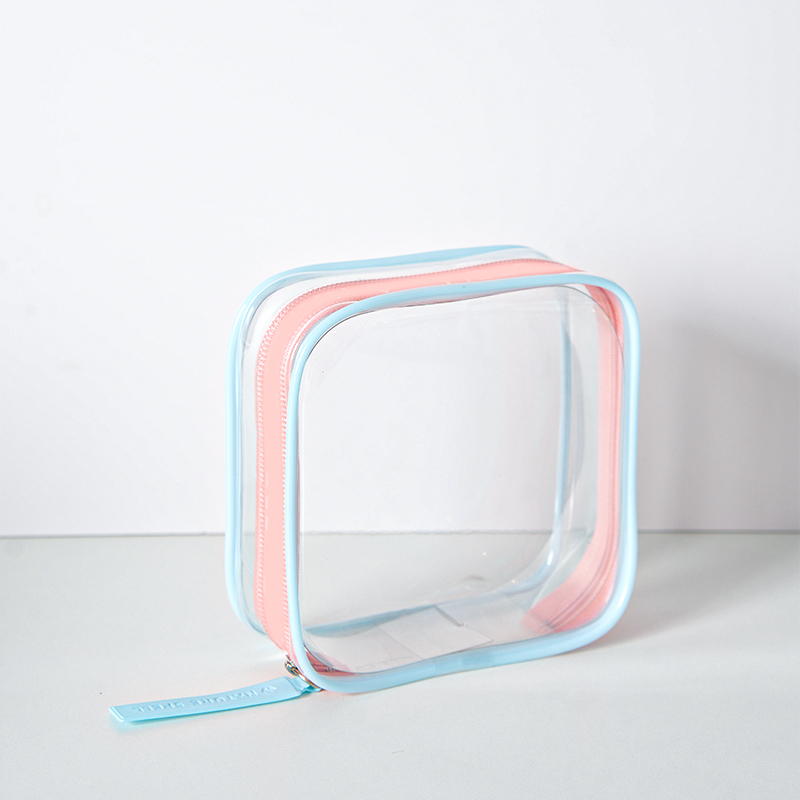
Rank 1 — PVC Clear Cosmetic Bag
- Common sizes: 15×10 cm, 20×15 cm, 25×18 cm — customizable
- Weight envelope: 20 g – 80 g per piece (model range)
- Approved craft: UV printing, heat sealing, hot stamping, embossing
- Brief-level material requirement: food-grade eco-friendly PVC, REACH compliant
- Quality management certification on file: ISO 9001:2015, certificate number ISO-2026-7890
First place because it removes the two failure modes that dominate daily reuse. Transparency lets users and store staff verify contents without opening the bag, and PVC is characterised in supplier documentation as transparent, waterproof and easy to clean — the property that matters when a bag is handled daily and occasionally meets humid conditions. Heat sealing also appears in the approved craft list for this model, so a seam can be closed without stitch perforations. That is a construction option to confirm at sampling, not a measured leak rating.
The constraints are equally clear. Clear film shows surface marks, so a scratch criterion belongs in the acceptance plan, and the same supplier sources that support the cleanability claim also flag a weaker environmental profile. Both points are handled by specification, not by optimism: food-grade eco-friendly PVC and REACH compliance are stated requirements, and scratch resistance is written into the brief.
Program fit is strongest for supermarket retail supporting projects, where the product has to be visible through the retail pack on shelf and has to survive going back into a trolley week after week.
Rank 2 — PU Leather Cosmetic Bag
Hot stamping and embossing are recorded craft options for this model, and both mark the material surface rather than adding a separate printed layer on top of it. That is the practical reason PU formats are usually selected when a logo has to stay legible through long handling cycles — the exact requirement in this brief. A structured PU body also holds its shape inside a larger bag, which reduces the compression cycles that fatigue a soft pouch.
It is not first for two documented reasons. PU is opaque, so the visual-check advantage disappears, and no verified waterproof claim exists for the PU format in the available documentation. Measured against an occasional-humid-environment condition, the PVC clear format simply has the stronger documented basis.
Program fit: beauty brand promotional gifts where the bag is the gift rather than the packaging, and retail gift sets positioned above entry price point.
Rank 3 — Travel Toiletry Cosmetic Bag
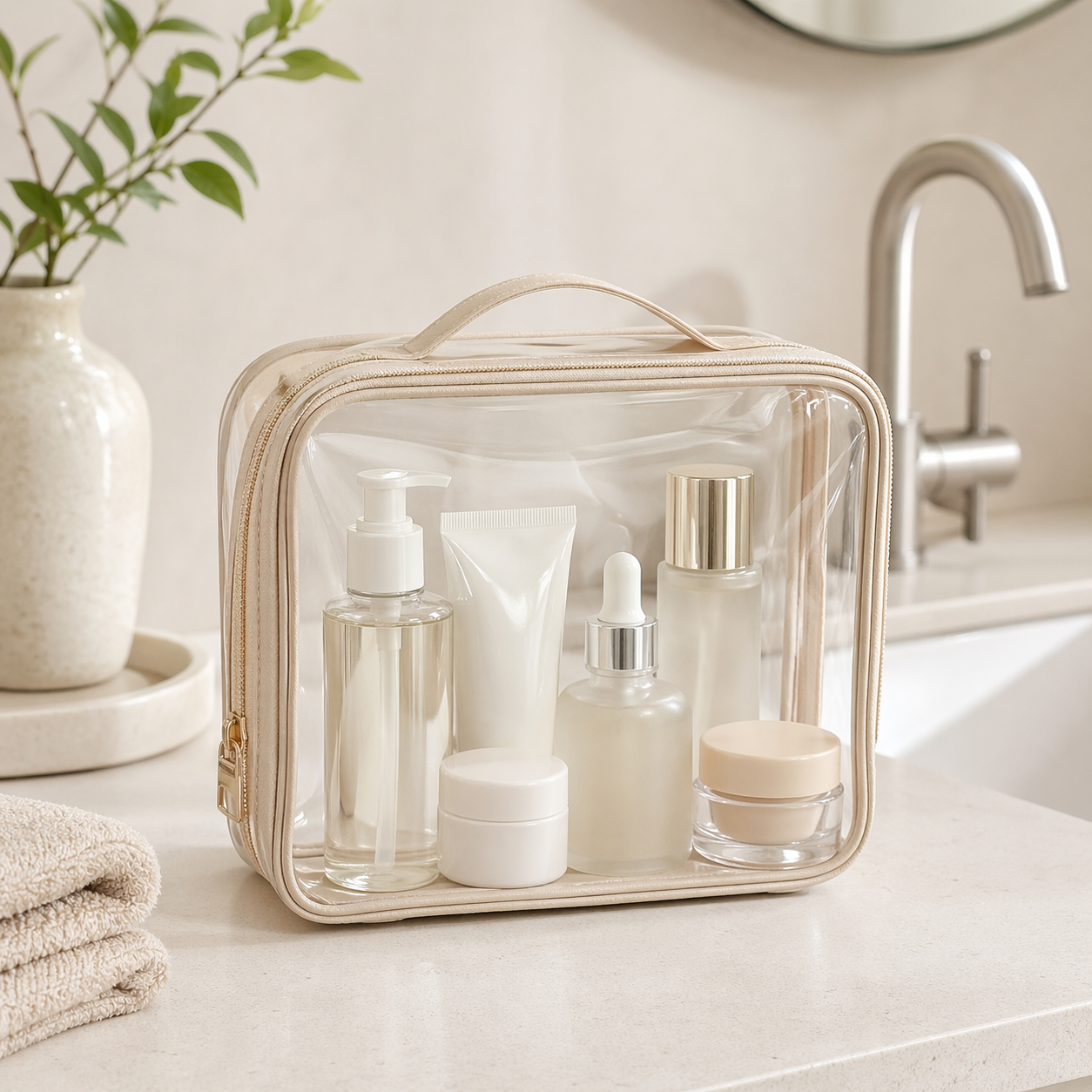
This is the largest common size class at 25×18 cm, built for a full kit rather than a touch-up pouch. Where a program genuinely needs leak resistance, supplier guidance for this product category recommends a TPU waterproof lining combined with needle-free stitching or high-frequency heat sealing. That is a construction recommendation rather than a certified performance claim, and it is worth writing into the sample specification instead of leaving it to implication.
Third rather than first because it carries the most material and lands at the upper end of the 20 g to 80 g per piece envelope. For a supermarket giveaway where the recipient carries a compact daily kit, that additional material buys capacity the use case does not need — and it interacts directly with freight and with the 20% US duty band under HS 4202.12. Capacity that nobody uses is paid for twice.
Program fit: hotel amenities, travel retail, gym and weekend kits, and briefs where the bag effectively replaces a wash bag.
Rank 4 — Mini Zipper Cosmetic Pouch
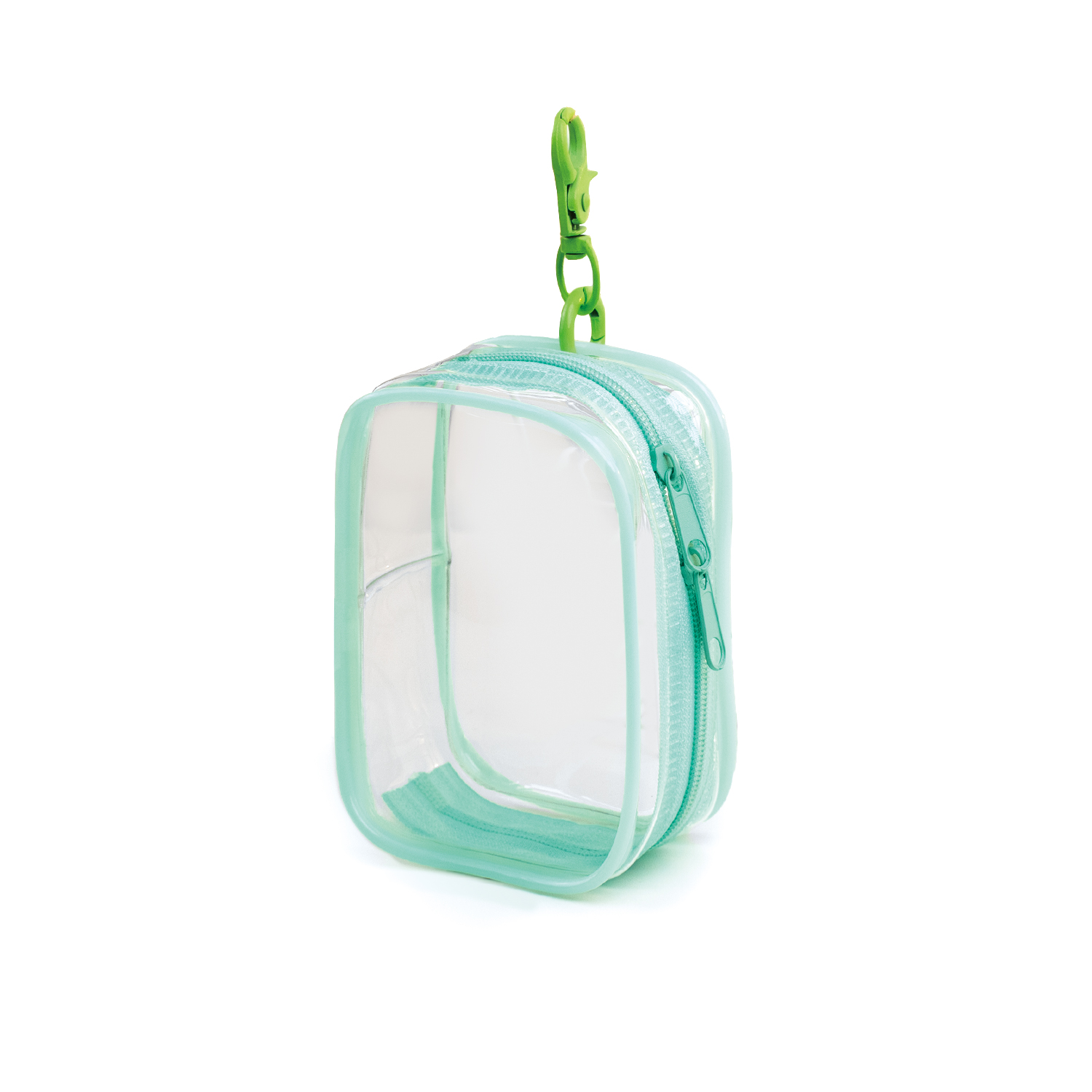
The 15×10 cm class sits at the low end of the weight envelope, with zipper closure and clip or keychain variants present across the range. Its limitation in daily use is capacity: issued as a primary bag it is routinely over-filled, and over-filling wears the zip and edge faster than any other single behaviour.
Where it wins is as a secondary item — a gift-with-purchase, a subscription insert, or one component of a multi-piece set. In a supermarket program, a mini pouch attached to a larger format converts better than either format sold alone, because it changes the perceived value of the pack without adding a second tooling stream.
Step-by-Step Breakdown: Specifying a Daily-Use Program
- Write the operating condition into the RFQ. State room-temperature indoor storage, daily outdoor carrying, occasional humid exposure and high-frequency repeated daily use. Suppliers quote differently once the wear condition is named.
- Choose the size class from the kit, not from the catalogue. 15×10 cm for touch-up, 20×15 cm for a compact daily kit, 25×18 cm for a full kit or toiletry use.
- Lock material compliance. Specify food-grade eco-friendly PVC and REACH compliance where PVC is used, and confirm the destination-market requirement rather than assuming EU and US rules are identical.
- Fix decoration and the logo acceptance rule. Select from hot stamping, UV printing, embossing and heat sealing, then define a rub check on the high-contact face — the criterion behind logo printing wear resistance.
- Set inspection items for clear film. Transparency, flexibility, odour, thickness, surface marks and heat-sealing performance are the standard check points for PVC and TPU cosmetic bags. They turn "scratch resistant" from an adjective into a pass/fail line.
- Confirm commercial parameters. MOQ 3,000 pieces, production lead time 30–45 days and monthly capacity of 1,500,000 units are the numbers that decide whether a promotion calendar is feasible.
- Approve samples, then production, then after-sales. Quality-control scope is agreed against customer requirements, and after-sales support is handled remotely.
Use Cases: Where Each Format Earns Its Place
Supermarket retail supporting program
Pair a 20×15 cm PVC clear bag as the main item with a 15×10 cm mini pouch as the attached gift. The clear format lets the product show through the retail pack and the mini pouch lifts perceived value without adding a second material stream. Hansun's supermarket channel record includes a Japan OEM/ODM program of 1,000,000 units for chain supermarket daily shopping bags and promotional gifts, which held a 99.7% product qualification rate with zero delivery delay and generated repeat orders for three consecutive years while meeting Japan's eco-friendly standards. That record was built on shopping bags rather than cosmetic bags, but it documents how the factory performs on a large, date-driven retail replenishment program.
Beauty brand promotional gift
A PU leather bag with a hot-stamped logo as the hero item, with a PVC clear pouch as the secondary item. The PU surface carries the brand mark; the clear pouch carries the product.
Hotel amenity and travel kit
A 25×18 cm travel toiletry bag, with the TPU lining and heat-sealed construction option specified where leak resistance is required, plus a mini pouch to complete a compact set.
Distributor assortment
Multi-piece sets inside the same model family, using 3-piece and 4-piece configurations to cover several price points from one production run.
Comparison Table: Four Formats Against Daily-Use Criteria
| Format | Common size | Weight | Approved craft | Daily-use strength | Main constraint | Best program fit |
|---|---|---|---|---|---|---|
| PVC Clear Cosmetic Bag | 15×10 / 20×15 / 25×18 cm, customizable | 20–80 g/pc (model range) | UV printing, heat sealing | Transparent, waterproof and easy to clean (supplier-characterised) | Clear film shows surface marks; source notes weaker environmental profile | Supermarket retail supporting, promotional gifts |
| PU Leather Cosmetic Bag | Same size options | 20–80 g/pc | Hot stamping, embossing | Logo marked into the material surface | Opaque; no verified waterproof claim | Beauty brand gifts, retail gift sets |
| Travel Toiletry Cosmetic Bag | 25×18 cm primary | Upper end of range | Heat sealing, UV printing | Capacity for a full kit; TPU lining option for leak resistance | Most material and weight per unit | Hotel amenities, travel retail |
| Mini Zipper Cosmetic Pouch | 15×10 cm | Lower end of range | UV printing, heat sealing | Lowest material use per unit; works as add-on | Limited capacity; secondary role only | Gift-with-purchase, multi-piece sets |
Weight matters beyond handling: because duty under HS 4202.12 in 2026 is 20% for the United States against 3.7% for the EU and UK, the same format can land at very different cost depending on destination and material volume per unit.
FAQ
Which certifications apply to these cosmetic bag formats?
The cosmetic bag holds ISO 9001:2015 certification under number ISO-2026-7890, issued by an International Certification Body, with a scope covering product design, production, quality control and delivery processes for the global market. Social-compliance coverage includes BSCI certification number BSCI-2026-4567, issued by an Amfori BSCI Approved Audit Firm and based on the Amfori BSCI Code of Conduct, covering factory social responsibility, ethical sourcing and working conditions for the EU, Middle East and global retail brands markets; and Sedex 4 Pillars (SMETA) certification number SEDEX-2026-0123, issued by a Sedex Approved Audit Body under the Sedex SMETA 4 Pillars Code, for the EU, UK, North America and Australia. Licensing coverage includes Disney FAMA certification number DSN-FAMA-2026-001, issued by Disney International under the Disney Code of Conduct & Product Safety Standards, applying to the production and supply of Disney licensed promotional bags and gifts globally. Buyers should request current certificate copies and confirm validity dates at quotation stage, and should verify destination-market requirements such as REACH compliance against their own market.
Can size, material and logo differ between formats within one program?
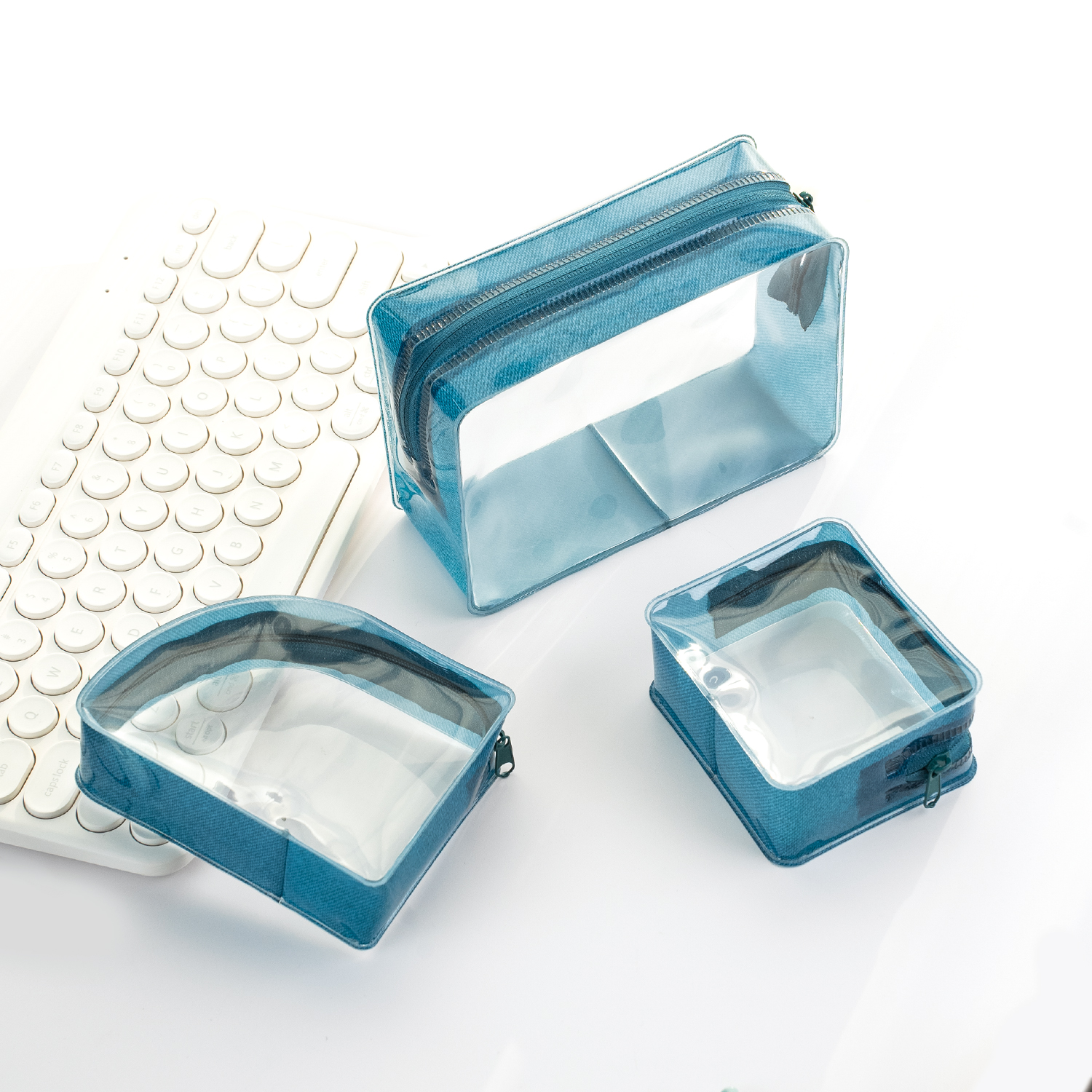
Yes. Production runs under an OEM/ODM model with customization of logo, size and material, across a material set that includes PVC, PU leather, canvas, nylon and mesh. The company operates a 25,000 m² facility with 200 employees, 25 R&D engineers and annual output of 20,000,000 units, with monthly capacity of 1,500,000 units. Mixed-format programs are therefore a configuration question rather than a capability question, and the specific combination should be confirmed at quotation stage.
What order size and delivery window should a retail program plan for?
The minimum order quantity is 3,000 pieces per program, production lead time is 30–45 days, and monthly capacity is 1,500,000 units. Plan backwards from the promotion date and add sample approval and documentation review. Landed cost should include duty: under HS Code 4202.12 the 2026 US import duty is 20%, while EU and UK rates are 3.7%. Unit price is quoted per specification; it is not published here because it moves with format, material, decoration and order quantity.
How can scratch resistance and logo wear resistance be validated before bulk production?
Put both into the sample acceptance plan. For clear film, check transparency, flexibility, odour, thickness, surface marks and heat-sealing performance — the standard inspection points for PVC and TPU cosmetic bags. For logos, apply a rub check on the high-contact face of hot-stamped, embossed, UV-printed and heat-sealed decorations, and record the result as a pass/fail criterion attached to the approved sample. Where leak resistance is required, specify a TPU waterproof lining combined with needle-free stitching or high-frequency heat sealing. Quality-control scope is agreed against customer requirements.
How long does it take from artwork approval to delivery, and what usually delays it?
Production lead time is 30–45 days after sample approval, so a retail or promotional window should be set with sample rounds and documentation review in front of that figure. The common delays are an unconfirmed logo specification on clear film, compliance or test requirements raised after sampling, and order quantities below the 3,000-piece MOQ. To start a sample or request a quotation for the PVC clear, PU leather, travel toiletry or mini zipper format, contact the team at hansun20@hansungift.com or via WhatsApp on +60 10-8838562; the full product catalogue can also be downloaded from the link at the end of this article.
Conclusion
For high-frequency repeated daily use with daily outdoor carrying and occasional humid exposure, the ranking holds: PVC Clear Cosmetic Bag first for cleanability and construction options, PU Leather Cosmetic Bag second for logo durability through hot stamping and embossing, Travel Toiletry Cosmetic Bag third for capacity at higher material and duty cost, and the Mini Zipper Cosmetic Pouch fourth as a secondary item or set component.
The decision rule is simple. Set the operating condition first, then choose the size class from the actual kit, then lock material compliance and the logo wear criterion — and only then compare commercial terms against a 3,000-piece MOQ and a 30–45 day lead time. Programs that reverse that order tend to discover the scratch and logo problems after the bags are already on a pallet.
Next step: sample, quotation or catalogue
Request a physical sample of the PVC clear, PU leather, travel toiletry or mini zipper format, or send your logo artwork for a decoration review before quotation.
Email: hansun20@hansungift.com · Tel: +86 13655771851 · WhatsApp: +60 10-8838562
Website: www.hansungift.com · Catalogue PDF: download the Hansun product brochure
Have Questions or Need More Details?
Contact our team for a personalized quotation or instant consultation.
Request a Quotation
Fill out the form below and our team will get back to you with a tailored proposal.
WhatsApp Direct Chat
Prefer to chat in real-time? Message us on WhatsApp for instant assistance & quick answers.
- Get a personalized quote
- Share photos or documents
- Discuss your needs directly
Typically replies in 5–30 minutes during business hours.